
Macro
Wall Street Bounced Back. How Much of the Sell-Off Did It Really Erase?
Monday’s 6.5% Nasdaq rally erased Friday’s drop, but a big rebound is not the same as a full recovery. Here’s what the numbers show and what to watch next.
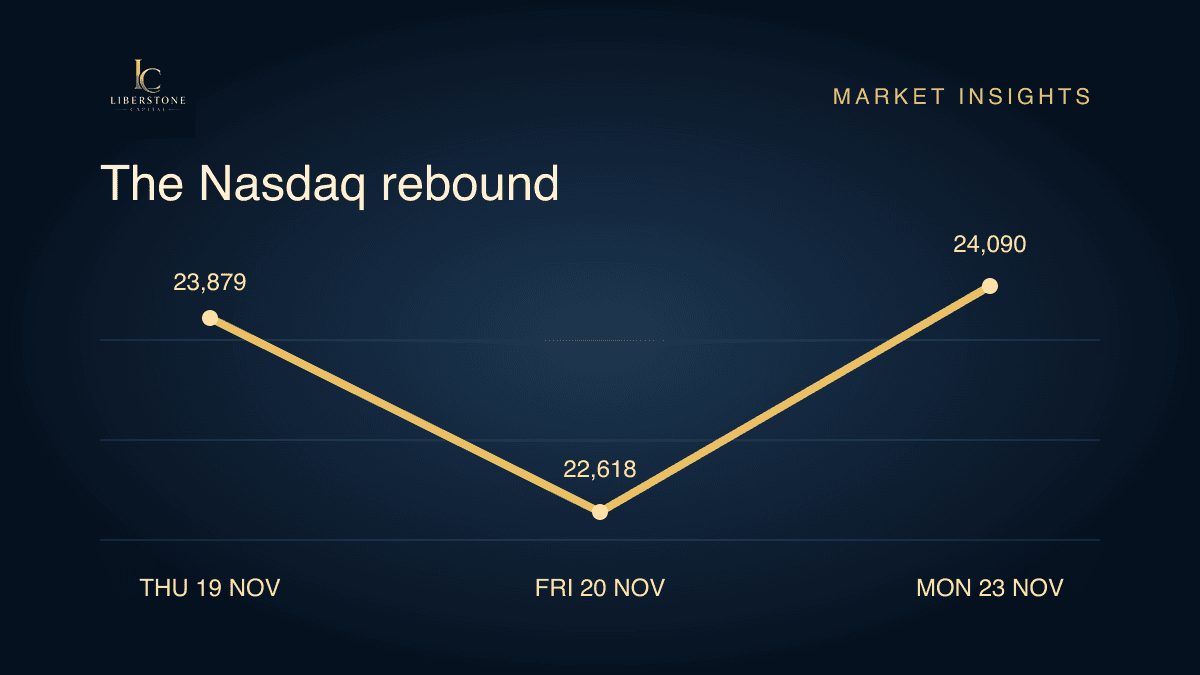
Published 24 November 2026. After Friday’s sharp sell-off, US stocks snapped back on Monday. The Nasdaq Composite rose 6.5% to 24,089.56, while the Dow rose 3%. Nvidia reinstated Jensen Huang as CEO, and AI-linked stocks helped lead the rally. Stock futures had already pointed higher before the announcement, so the leadership reversal was not the only thing moving markets. Source: apnews.com
What the rebound actually recovered
The Nasdaq Composite closed Thursday at 23,879.20 and Friday at 22,617.74 before closing Monday at 24,089.56. Monday’s gain put it about 0.9% above Thursday’s close. The arithmetic matters: Friday’s loss and Monday’s gain were measured from different starting points, so simply subtracting the two daily percentages would overstate the recovery. Sources: apnews.com and apnews.com
That comparison answers a narrow question: did the Nasdaq undo Friday’s drop? Yes. It does not answer whether Wall Street recovered the full prior week’s losses. AP reported that Monday’s S&P 500 rally recovered roughly half of that index’s previous weekly decline. The benchmark and the starting date both change the answer.
Gold rebounded too, but rates told a different story
Reuters reported that gold extended its rebound early Tuesday after touching a 14-month low the previous week. Meanwhile, AP reported that the 10-year Treasury yield edged up to 4.93% Monday from 4.92% late Friday. The equity rebound therefore did not come with a fresh drop in the benchmark yield. Nor does a recovery in both gold and stocks establish that they rose for the same reason. Sources: uk.marketscreener.com and apnews.com
What would make the recovery more convincing?
Look for more stocks and sectors to participate after the initial bounce, and for gains to hold through the next US inflation release. A rally concentrated in a few AI names would say more about sentiment toward those companies than about the health of the wider market. A broader advance that holds even if yields rise would offer stronger evidence that investors are willing to take risk again. For now, the clearest conclusion is that the Nasdaq recovered Friday’s losses, not that the wider sell-off is over.
This article is market commentary, not investment advice.